

HISTORIC BACKGROUND
Rubya Hospital is situated in Kagera Region in North West Tanzania. Kagera region borders Uganda to the North, Rwanda and Burundi to the West and Lake Victoria to the East. Rubya is the Designated Hospital for Muleba District.
Muleba District covers an area of approximately 2500 square kilometers with a total population of 386,320 in habitants according to the 2002 census.
The hospital was opened in 1956 by the Franciscan Sisters of Breda from the Netherlands, under Bukoba Catholic Diocese. It gradually developed from a small Pre-existing dispensary with 20 maternity beds run by the Bukoba Diocese. Over the years the complex was expanded until it reached its present size. Since then Rubya Hospital has consisted of a main building that is made up of Theatre, X-ray room, Pharmacy and administrative offices. Besides there are seven wards: Male ward, Female ward, Children ward, Top ward, Maternity ward Private ward and Nutrition Unity. There is a separate outpatient department containing Laboratory and a separate unit for RCH (Mother and Child Health). Next to the Hospital there are relative quarters with a small market where daily earnings are done. Most of the Medical staff and Nursing staff live in the Hospital premises.
In 1977 the Hospital became the Designated District Hospital of Muleba District. This means that a major part of running costs of the hospital are paid by the government, based on 162 official beds. The Hospital has remained under the ownership of Bukoba Catholic Diocese. Since 1977 patients were treated free of charge, but in February 1994 cost sharing was introduced as stipulated by the Government.
GEOGRAPHY & POPULATION
Muleba district is situated in Kagera region in northwest Tanzania. Kagera region is bordered by Uganda to the north, Rwanda and Burundi to the west and Lake Victoria to the east. The region is divided into 8districts, Muleba being one of them.
Rubya is the designated hospital for Muleba district. Muleba District covers an area of approximately 2500 square kilometers with a total population of 386,320 inhabitants in 2002 census (457,600projected populations for 2009). It has 5 main divisions Nshamba, Muleba, Kamachumu, Kimwani, and Izigo. Nshamba division is a catchment area for Rubya hospital which is estimated to have approximately 1/3 of the district population. Besides Rubya Hospital there are two non-governmental (fee-paying) hospitals in Muleba district namely Ndolage Hospital in Kamachumu division, 25kilometers from Rubya.and Kagondo Hospital in Izigo division,45 Kilometers from Rubya. Other health facilities in muleba district include 3 health centers: Kaigara health centre in Muleba division, kimeya health centre in kimwani division and Kamachumu health centre in Kamachumu division.
Also there a number of dispensaries run on governmental and private basis. In reality more people come to Rubya Hospital, probably the other two Hospitals are more pass the peripheral dispensaries and health centers and come directly to Rubya hospital to receive health care without being reffered. The cause of by passing is not yet known. The climate of Muleba District is mild with 2 main rainy seasons, one from March to May and the other from September until December. The average rainfall varies between 800-1600mm per year.soil erosion is due to woodcutting and overgrazing and is one of the serious problems in some areas.
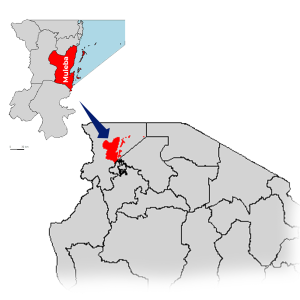
Rubya lies Nshamba division, on the west side of high sandstone plateau on an altitude of 1500 meters above sea level overlooking the ngono plains. The Hospital is 85kilometers from Bukoba town, which is the regional capital, and 20 kilometers from Muleba where the district headquarters are located. Rubya hospital is 20 kilometers off the main road Bukoba -Biharamulo- Mwanza.
Also there is good communication by public transport to and from Muleba, internet services to communicate within and outside the district through e-mail. Availability of reliable electricity had contributed much to the development. Despite the improvement of public transport, patients are coming on foot, bicycles and homemade stretchers due to geographical physical features. Hospital drugs and other major requirements are bought from medical store Department (MSD) Mwanza around 400 kilometers by car and difficult to reach in the rainy seasons. However, availability of drugs at MSD is still a problem. Patients can be referred to Bukoba region Hospital, Bugando Medical Center in Mwanza, Kilimanjaro Christian medical centre (KCMC) in Moshi and Muhimbili National Hospital in Dar es Salaam this can be done by referring patients physically or by using telemedicine.


COMMUNITY & HEALTH STATUS
Muleba District is divided into 5 divisions with 31 wards (subdivisions). The majority of the people are Haya by triple but there are also some immigrants from Rwanda and Burundi who alive among citizens; however the district authority is making efforts to make sure that non-citizen are returned back to their homes. The language of daily life is Kihaya; Kiswahli The nation language is mostly spoken in tradition centers and towns but rarely; used in villages. The main religions of the area are Christianity (predominantly roman catholic), Protestants and the Muslims.
AGRICULTURE
Majority of people are peasants cultivating their own plots. Staple food consists of bananas that are available almost throughout the year. However, the banana trees are infested with weevils resulting in decreasing yields. Other products grown are maize, Beans, groundnuts, cassava and sweet potatoes. Some have small vegetable gardens for home use. Few gardens produce enough vegetable to sell at the local markets. Coffee is the only cash crop grown. It is sold at co-operative unions and being processed in the coffee factory in Bukoba. Many families own either chickens, goats or both.
HEALTH STATUS
Vulnerable groups among the population include pregnant mothers, under five children and orphans. The under five – mortality rate is fluctuating. The childbearing group suffers from conditions related to pregnancy and pregnancy outcome.
HEALTH POLICEY & INFRASTRUCTURE
Muleba District 5 divisions and each division has at least one major health facility. There are 3 hospitals and 5 health canters. The 3 hospital in the area (Kagondo, Ndolage,Rubya) act as referral centre for the Dispensaries and health canters. For many unclear resounds patients by pass dispensaries and health canters without being referred .The health care delivery system in Muleba District focuses on curative and preventive activities.
Rubya Hospital several system programme are inc-operated with our daily activities, these include.
- Malaria control programme /sentinel site
- Atoll health programme,
- Expanded programme of immunization
- Nutrition programmer
- National tuberculosis and leprosy control programme (NTLP)
- National AIDS control programme ( NACP) CTC, VCT PMTCT, HBC, EID, PE, MC
” Primary health care activities done in Rubya hospital are in accordance with the national policy. The government and development partners used to sufficiently fund these programs but recently not all programmer are funded.”